

The Global Spice Export Market: A Quick Overview
The spice market has always held great importance in global trade. By 2025, the worldwide spice market is projected to grow significantly, driven by lifestyle changes, increasing interest in organic foods, and rising awareness about medicinal herbs. Among all spices, turmeric is seeing one of the fastest growth rates.
India contributes nearly 75–80% of global turmeric production, making turmeric export in India a crucial part of the country’s agri-export economy.
Why Turmeric Stands Out Among All Spices
Turmeric is not just a culinary ingredient—it is a superfood.
Key Reasons Turmeric Is Leading the Spice Market
- Rich in curcumin, a powerful antioxidant
- High demand in the pharmaceutical, food, and cosmetics industries
- Key ingredient in natural immunity-boosting products
- Significant use in traditional medicine like Ayurveda and TCM
- Versatile applications in beverages, supplements, and natural dyes
This growing versatility ensures turmeric export in India remains strong and steady.
Global Demand & Market Trends for Turmeric (2025)
The global turmeric market trends 2025 indicate remarkable growth:
Major Market Trends
- Increasing demand for organic turmeric powder
- Rising popularity of curcumin supplements
- Growth of turmeric-based ready-to-drink beverages
- Higher imports from countries like the USA, UAE, Japan, Germany, and the UK
- Rising use in vegan, gluten-free, and natural wellness diets
These trends highlight why turmeric export from India is set to rise sharply in the coming years.
How India Leads in Turmeric Export
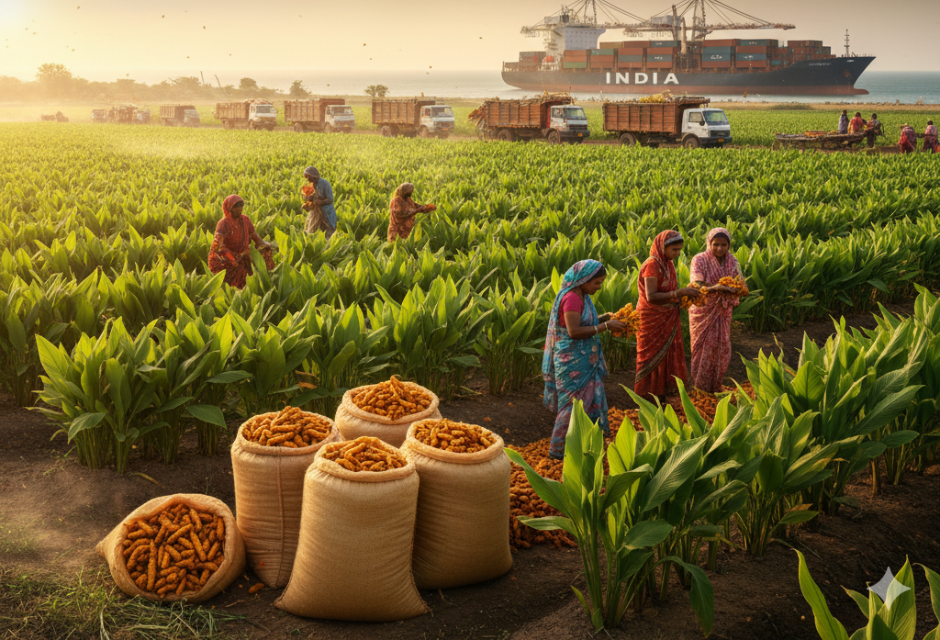
India is the undisputed leader in turmeric trade for many reasons:
Why India Dominates the Global Turmeric Market
- Largest global producer of turmeric
- High-quality varieties such as Salem, Erode, Rajapore, and Nizamabad
- Strong domestic value chain
- Skilled farmers and advanced post-harvest processes
- Growing adoption of organic and residue-free farming
Together, these factors make turmeric export in India a rapidly growing industry.
Indian Government Policies Supporting Turmeric Export
India’s government is actively supporting spice exports through:
- MEIS / RoDTEP export scheme benefits
- Spice Board India quality certification programs
- Support for organic certification (NPOP, PGS-India)
- Subsidies for processing, irradiation, and packaging units
- Export promotion through APEDA
These policies strengthen turmeric export in India by improving farmer income, export quality, and global competitiveness.
Top 5 Indian States for Turmeric Production
Major Turmeric-Producing States
- Telangana – Largest producer with Nizamabad as a major hub
- Maharashtra – Known for Rajapuri and Sangli turmeric
- Tamil Nadu – Popular for Erode and Salem varieties
- Karnataka – High curcumin content varieties
- Andhra Pradesh – Significant contribution to organic turmeric
These states contribute heavily to the turmeric export in India, supplying premium-quality crops.
You Can Read Also: Why Indian Turmeric Dominates the Global Spice Market
What Role Do FPOs Play in the Turmeric Value Chain?
Farmer Producer Organizations (FPOs) are transforming the turmeric sector:
Key Contributions of FPOs
- Help farmers access premium export markets
- Ensure consistent quality and volume
- Provide training in GAP (Good Agricultural Practices)
- Make grading, polishing, and processing more efficient
- Improve packaging and reduce middlemen dependency
FPOs play a big role in strengthening turmeric export in India, ensuring global buyers receive uniform quality and traceability.
Challenges and Opportunities in Turmeric Export

Challenges
- Price fluctuations
- Quality variation
- Lack of advanced post-harvest facilities
- International quality compliance requirements
- Limited access to global certification
Opportunities
- Growing organic turmeric demand
- High curcumin varieties fetching premium prices
- Rising demand for turmeric extracts and oleoresins
- Increasing export opportunities to Europe and North America
- More government support for spice exporters
Even with challenges, opportunities for turmeric export in India are expanding rapidly.
Future Trends: What Lies Ahead for Turmeric Exporters
Predictions for the Future
- Huge rise in curcumin extract exports
- Expansion into the wellness, skincare, and nutraceutical sectors
- More start-ups entering value-added turmeric processing
- Blockchain-enabled traceability for international buyers
- Rising demand for ready-to-use turmeric beverages and supplements
The future of turmeric export in India is bright and full of innovation.