
What Is Curcumin Content in Turmeric and Why It Matters for Buyers

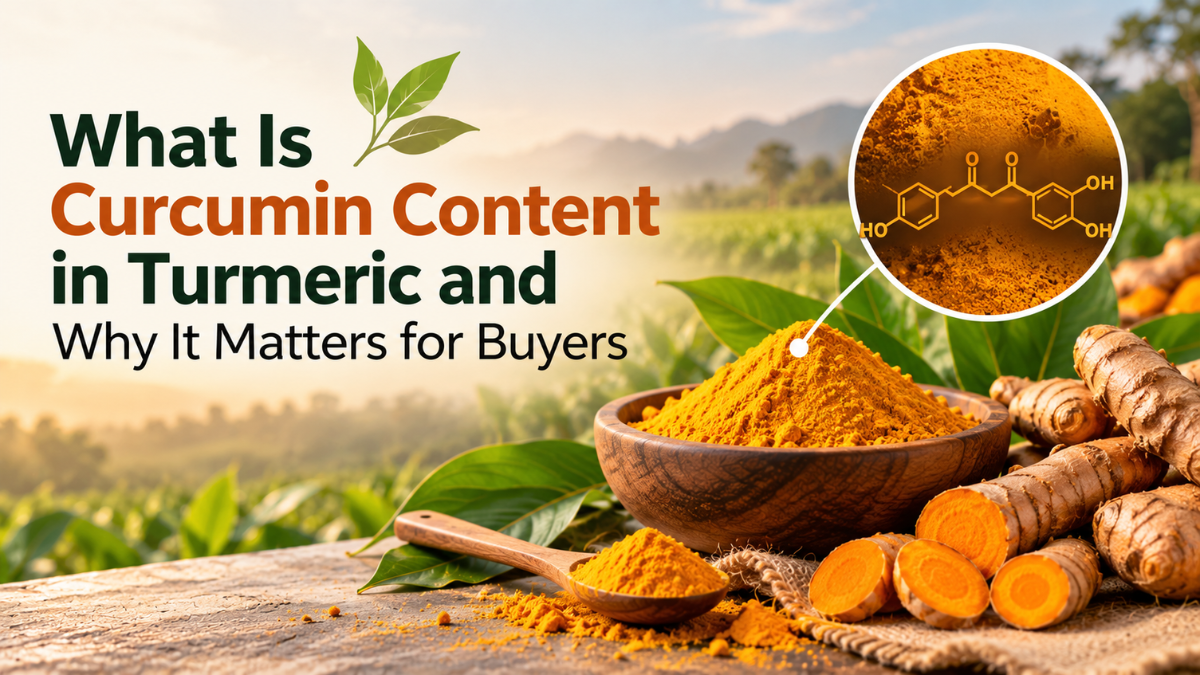
If you are sourcing turmeric for food manufacturing, nutraceuticals, or health supplements, you have likely come across the term curcumin content. Curcumin is the most important quality indicator for turmeric — and understanding it will help you make better buying decisions. In this article, we explain what curcumin is, why it matters, how Indian turmeric compares globally, and how to choose the right grade for your application.
What Is Curcumin?
Curcumin is the primary active chemical compound (polyphenol) found in turmeric (Curcuma longa). It is responsible for turmeric’s deep golden-yellow colour and its well-documented anti-inflammatory, antioxidant, and antimicrobial properties. Curcumin makes up approximately 2%–8% of dried turmeric, depending on the variety and growing region.
Why Does Curcumin Content Matter?
For food manufacturers, higher curcumin content means stronger colour and flavour impact per kilogram of turmeric used — reducing the quantity needed in recipes. For nutraceutical and supplement brands, curcumin content directly determines the potency of capsules, tablets, or extracts. For cosmetic manufacturers, curcumin’s antioxidant properties make it a key active ingredient in skin care products. In short — higher curcumin = higher value, higher price, higher demand.
Curcumin Content in Indian Turmeric Varieties
India is the world’s largest producer of turmeric and offers several distinct varieties, each with different curcumin levels:
- Alleppey Finger Turmeric (Kerala) — 5%–7% curcumin. Best for supplements, nutraceuticals, and premium food.
- Erode / Salem Turmeric (Tamil Nadu) — 3%–5% curcumin. Best for food manufacturing and spice blends.
- Nizamabad Bulb Turmeric (Telangana) — 2%–4% curcumin. Best for general cooking and curry powders.
- Sangli Turmeric (Maharashtra) — 3%–4% curcumin. Standard export-grade cooking spice.
Alleppey vs Madras Turmeric — Which Should You Buy?
Alleppey (Alleppey Finger Turmeric) is the gold standard for high-curcumin turmeric. With 5%–7% curcumin, it commands a price premium and is the preferred choice for supplement brands, health food manufacturers, and premium spice blenders. Madras / Erode Turmeric is more widely used in food processing because it offers a good balance of curcumin content and cost. It provides a bright yellow colour suitable for curry powders, mustards, sauces, and ready meals.
Buyer’s Rule: If you are manufacturing supplements or extracts, always specify Alleppey Finger Turmeric with a minimum curcumin guarantee of 5%. If you are buying for food manufacturing or colour, Erode or Nizamabad turmeric at 3%–4% curcumin offers better value for money.
How to Verify Curcumin Content When You Buy
Always request a Certificate of Analysis (CoA) from an independent, accredited laboratory before accepting a shipment. The CoA should specify: curcumin content (%), moisture content (should be below 10%), total ash and acid-insoluble ash (purity indicators), lead, cadmium, and arsenic levels (heavy metals — critical for supplement use), and microbial count (TPC, E. coli, Salmonella).
How Sattvaya Ensures Curcumin Quality
At Sattvaya, every batch of turmeric is sourced directly from verified farms and independently lab-tested before shipment. We provide full CoA documentation with every order, and we offer both Alleppey and Erode turmeric varieties to match your application and budget. Our turmeric is available as whole fingers, sliced, and powder in grades from 3% to 7% curcumin.
Request your turmeric sample with CoA — Contact Sattvaya today.